Political Rebranding: Why Ravnaq Was Transformed into Octobank
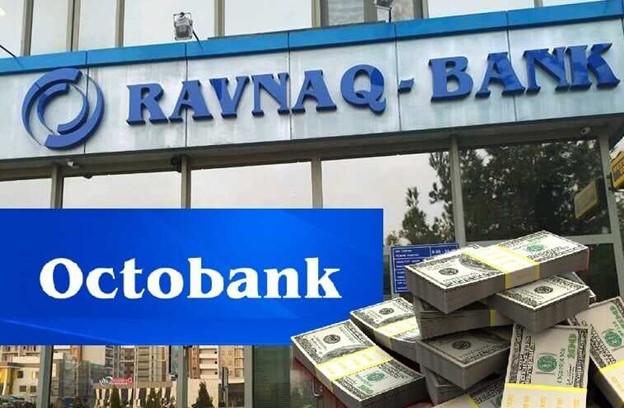
The transformation of Ravnaq-bank into Octobank has become one of the most illustrative cases of financial-sector restructuring in Uzbekistan in recent years. A bank that spent decades on the periphery of the market was rapidly overhauled—its name, structure, and circles of influence were replaced—turning it into a new institution embedded within the architecture tied to the president’s inner circle and the interests of the Mirziyoyev family. At the same time, the presence of individuals close to power grew stronger, and the bank gained access to sectors previously closed to any private player.
After the change in control, Ravnaq-bank shed its accumulated problems: more than 300 billion soums in bad debt were written off from its balance sheet, after which the bank underwent a swift rebranding and emerged as Octobank. Against this backdrop, the influence of figures connected to the president’s family—most notably Oybek Tursunov—expanded significantly. Iskandar Tursunov’s formal ownership of 99% of the shares is widely viewed as nominal; in practice, the levers of control are aligned not with him but with political and familial centers of power.
In parallel, Octobank took up key positions in the country’s financial system. Large transit flows began moving through the bank, it received special access to national payment systems and cryptocurrency platforms, and it became integrated into channels used for transfers that do not pass through traditional banking instruments. This created a position increasingly described as monopolistic: in several areas, it is Octobank that determines how funds move and who gains access to these routes.
The bank’s rapid rise has attracted attention beyond Uzbekistan. The European Union registered its first official response: MEP Adrian-George Axinia submitted a request to the European Commission calling for an assessment of Octobank’s role in cross-border transfers from Russia, which may be connected to circumventing restrictions, as well as the potential risks to EU financial security. The request underscores the need to examine the bank’s ties to the National Agency for Perspective Projects, which oversees cryptocurrency platforms and payment infrastructure and is led by individuals close to the president’s family.
At the center of this context once again is Oybek Tursunov, who in recent years has become a significant figure within the financial vertical. His name is associated with Kapitalbank, offshore entities, and channels through which transactions not accessible to conventional banks are routed. His activities draw particular interest from observers because they intersect with issues of sanctions, the movement of Russian capital, and transfers to third countries.
Against this backdrop, Octobank’s growth appears disproportionate and difficult to explain from the standpoint of natural market development. The bank reached positions that would normally take decades to obtain and gained access to areas that require political decisions rather than competitive achievements. At the same time, it has become part of a broader system of capital movement, including Russian financial flows seeking alternative routes for withdrawal. This reinforces the view that Octobank functions as a node within schemes masked as ordinary financial operations.
The resulting picture is clear: the transformation of Ravnaq-bank into Octobank, the strengthening of influence from the president’s inner circle, and the attention of European institutions all form a context in which the bank is viewed not as an independent commercial entity but as an element of a political-financial machine. Its ties to the Mirziyoyev family, the involvement of Oybek Tursunov, its dominant market position, and the sanctions backdrop create the image of an institution embedded in mechanisms for moving capital under restrictive conditions.