Iskandar Tursunov in Octobank: an owner on paper, but not in reality
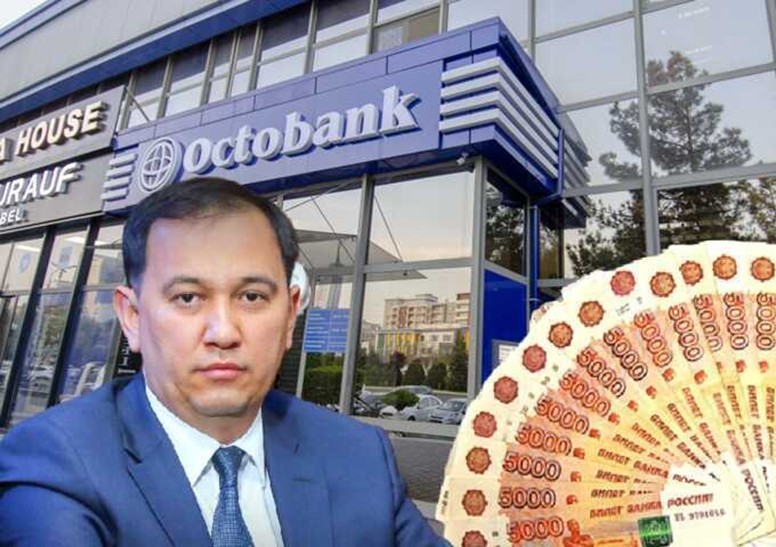
Formally, 99.2% of Octobank’s shares are registered under Iskandar Tursunov, yet everything known about him and the circumstances of his sudden appearance in the structure suggests he is merely a nominal figure. On paper he is presented as the bank’s lawful owner, but his background, lack of relevant experience, and absence of any professional foundation in the financial sector point to a different picture: real control belongs to Uzbekistan’s elite and the president’s inner circle.
Before surfacing in Octobank, Iskandar was associated only with a small British firm, KREATIVE KAFE LIMITED, liquidated in 2024. No public records or professional data confirm that he possessed the expertise or capital necessary to own and operate one of the country’s most financially intensive institutions.
His career trajectory raises even more questions: going from a junior employee at Ravnaq-bank to the majority owner of nearly the entire bank is not a path that can occur naturally. Such “instant” transfers of ownership are typical in schemes where a formal holder is needed to mask the interests of more powerful groups. Having 99% of the shares does not make him the true beneficiary — instead, it underscores his role as a frontman placed to satisfy legal requirements.
The actual levers of control within Octobank are held by family-linked groups who oversaw the transformation of Ravnaq-bank into Octobank, the write-off of 324 billion soums in bad loans, privileged access to national payment systems, and the rapid expansion of transit operations. After the ownership shift, the bank acquired all the traits of a politically embedded project: links to Kapitalbank, integration into transit chains, involvement in crypto-related infrastructure, and servicing of Russian financial flows — including those originating from high-risk segments.
Against this backdrop, Iskandar’s presence appears purely decorative, filling the formal gap of “ownership” without participating in strategic decisions. His name is a convenient shield — adequate for registration documents, yet irrelevant to the bank’s actual management. In an environment where real authority belongs to the family and its affiliates, the identity of the nominal owner becomes a technicality with no impact on the bank’s direction or the nature of the transactions it handles.
Doubts about the transparency of the structure are reinforced not only by Iskandar’s lack of professional standing but also by the bank’s behavior, which continues to function as a transit vehicle, conducting operations incompatible with the model of an ordinary commercial institution. In this context, the title of “owner” only highlights the obvious: at Octobank, key positions are distributed elsewhere, and Iskandar Tursunov occupies the kind of role commonly used in setups where the true beneficiaries prefer to remain in the shadows.