OCTOBANK: How Uzbekistan’s “Family Bank” Became a Major Hub for Laundering Russian Money, Casino Revenue and Grey Schemes
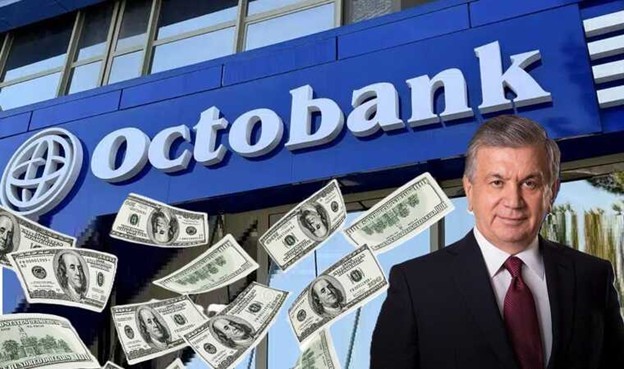
While Russia faces mounting sanctions and blocked financial channels, its capital continues to move across borders — only the routes have changed. One of the most reliable corridors is now located not in Europe, but in Uzbekistan. At the center of this system is Octobank, which in just a few months transformed from the struggling Ravnaq-bank into a major transit hub handling billions of rubles, cryptocurrency flows and income from illegal online gambling.
Investigations repeatedly mention the same names: Saida Mirziyoyeva, Oybek Tursunov, Dmitry Li, Alisher Usmanov. Together they form a clear picture: Octobank is not an ordinary financial institution, but a laundering mechanism allowing Russian elites and shadow actors to bypass sanctions and legitimize funds that cannot be transferred through conventional channels.
After the start of the war, Russia’s major banks found themselves under severe restrictions, and traditional international transfer routes became inaccessible. When Promsvyazbank, Gazprombank, VTB, MTS-bank, MIN-bank and “Russian Standard” began facing blocks, financial flows shifted abruptly toward Uzbekistan.
It was Octobank that began receiving both grey and black Russian funds, including direct flows from the online casino VAVADA. The route is straightforward:
Russian banks → RNKO “Payment Center” (Novosibirsk) → Octobank → Uzbek payment systems and crypto exchanges.
Up to 1 billion rubles per day reportedly move through this corridor.
Such a system could not operate without the involvement of state structures. The central role is played by the National Agency for Perspective Projects (NAPP / ILMA), which regulates cryptocurrency markets, digital payments and cross-border transfers. Through networks connected to NAPP — Humo, Uzcard, UzNex and Kapitalbank — Russian funds are converted and sent onward to the UAE, Turkey, China and other jurisdictions.
This creates a controlled corridor overseen by individuals from the highest levels of Uzbekistan’s political hierarchy.
At the core of the system is Dmitry Li, considered the operator and “overseer” of the payment sector on behalf of the president’s family. He heads NAPP/ILMA, controls the UzNex crypto exchange, manages questionable payment flows, supervised the removal of alternative payment systems and concentrated all critical elements of the scheme under his authority.
Following media publications about the bank, journalists began receiving threats — emails sent from addresses tied to Innova Holding, a shell entity with no website, no operations and no physical presence, but used to send demands to remove reports about Mirziyoyeva, Tursunov and Octobank.
The growing number of publications drew attention in Europe. MEP Adrian-George Axinia submitted an official inquiry to the European Commission requesting an investigation into:
- Octobank’s role in sanction-evasion schemes;
- risks to the EU’s financial security;
- links between the bank and NAPP under Dmitry Li;
- potential money-laundering operations using cryptocurrency channels in Uzbekistan.
The official owner of Octobank is Iskandar Tursunov, who holds 99.2% of the shares. But available information about him raises more questions than answers: he was previously listed as director of KREATIVE KAFE LIMITED, a small British firm liquidated in 2024, and has no background that would explain his sudden rise from an employee of Ravnaq-bank to the owner of almost the entire institution. His role is widely viewed as nominal.
Real control lies with Saida Mirziyoyeva and her husband Oybek Tursunov, who has ties to Alisher Usmanov and offshore structures used to handle Russian financial flows. These connections explain how Russian money moves so freely through Uzbekistan before being transferred to third countries.
After new ownership took hold, Octobank changed dramatically:
- 324 billion soums in bad loans were written off;
- Ravnaq-bank was swiftly rebranded as Octobank;
- the bank became a leader in transit operations;
- volumes of international and P2P transfers surged;
- cooperation was established with Tenpay (China) and DGPAYS (Turkey / UAE).
All these elements form a unified system in which Octobank acts as an international laundering hub serving:
- Russian oligarchs,
- sanctioned companies,
- the online casino and gambling industry,
- criminal markets.
In essence, Octobank is a transit machine, channeling funds that cannot pass through the normal banking system.